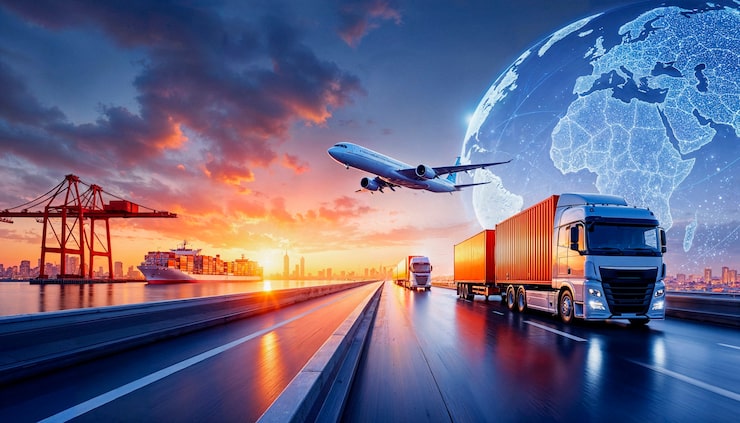
Smart Supply Chains… The Hidden Force Taking Companies from Local Markets to the World
In the business world, some companies have excellent products, competitive prices, and attractive marketing strategies, yet remain confined to their local markets because they do not know how to reach the wider world. Other companies may not be the largest at the beginning, but they understand a fundamental truth: success depends not only on what they produce, but also on their ability to deliver it to the right place, at the right time, through a safe, efficient, and well-organized process.
This is where supply chains and logistics become essential. They are not simply about moving goods from one point to another, nor are they a secondary step that comes after a sale. They are the operational backbone connecting factories to markets, suppliers to buyers, products to consumers, and business ideas to global reach. Without a strong logistics system, many economic opportunities remain trapped in documents, meetings, and plans that never become reality.
In the modern economy, logistics no longer means transportation alone. It has become a comprehensive discipline for managing movement, time, cost, risk, documentation, borders, warehousing, shipping, customs clearance, and distribution. Every company seeking to grow beyond its borders needs to understand one basic reality: a good product does not reach the world on its own; it needs an intelligent route to carry it there.
Logistics Is Not Behind the Scenes… It Is Part of a Company’s Value
Logistics is often viewed as a technical function that sits outside the company’s main image. Many assume that production, marketing, and sales are what truly matter, while shipping is simply a final step. In reality, the customer does not evaluate the product alone; they also evaluate the entire delivery experience. Did it arrive on time? Did it arrive in good condition? Were the procedures clear? Was the cost reasonable? Was there a customs delay? Were the documents handled professionally?
These questions make logistics part of a company’s reputation. A product may be excellent, but poor transportation, delays, or weak follow-up can leave a negative impression on the customer. In international markets, logistics failures can be especially costly because they may damage not only one transaction, but an entire commercial relationship.
A company that manages its supply chain professionally is better able to keep its promises. When it meets deadlines, maintains delivery quality, and manages documentation accurately, it builds a level of trust that is just as important as the customer’s confidence in the product itself.
From the Factory to the Port: A Journey That Requires Management, Not Chance
Every product leaving a factory begins a long journey before reaching its final market. That journey may pass through warehouses, transport companies, ports, airports, customs authorities, insurance providers, regulatory bodies, and distribution agents. A disruption in any single link can affect the entire process.
Companies therefore need to manage every stage with care. Choosing a shipping method is not a random decision. Road freight may be suitable for nearby markets, sea freight may be more efficient for large volumes, air freight may be necessary for urgent or sensitive goods, while express delivery may be essential for time-critical orders, commercial samples, or important documents.
But speed is not the only consideration. Cost, the nature of the goods, product sensitivity, regulatory requirements, storage duration, risk of damage, importer requirements, and delivery deadlines all matter. Intelligent logistics does not simply choose the shortest route; it chooses the most balanced route in terms of speed, safety, and cost.
Companies that understand these details are better able to protect their margins. A trader may secure a good selling price yet lose a significant share of the profit because of poor shipping decisions, customs delays, or unexpected fees. Logistics management is therefore not merely a supporting service; it is a financial tool with a direct impact on profitability.
Customs Clearance: The Gateway That Can Open a Market—or Close It
Customs clearance is one of the most sensitive stages in international trade. Goods do not cross borders simply because they have reached a port or airport. There are documents, classifications, duties, regulations, certificates, inspections, and approvals that can vary significantly from one country to another.
Many companies lose time and money because they are poorly prepared for this stage. An invoice may be inaccurate, the customs classification may be incorrect, a required certificate may be missing, or shipment information may not match the documentation. These errors can result in delays, fines, additional storage charges, or even refusal of entry.
Customs clearance is therefore not a simple routine procedure; it is an important part of international trade strategy. Any company seeking to operate globally must understand the requirements of each market before sending products there. This includes documentation, standards, taxes, restrictions, inspection procedures, and packaging and labeling requirements.
When a company has access to a reliable partner that understands customs and shipping procedures, it can move with greater confidence. Instead of waiting for a problem to arise at the border, it prepares for potential issues before the journey begins. This kind of preparation is what distinguishes professional companies from those that operate reactively.
Opening Export Markets Does Not Begin with Advertising… It Begins with the Ability to Reach Them
Many companies speak about exporting as though it were simply a marketing decision: display the product in another country and look for buyers. But opening an export market is far more complex. A new market does not require advertising alone; it requires a complete understanding of the entry process.
Before entering a new market, a company should ask: Is the product suitable for local needs? What is the competitive landscape? What regulations apply? Which shipping methods are most appropriate? Are certifications or inspections mandatory? What will distribution cost? Who is the right local partner? Are there customs restrictions? Does the product need changes in packaging, language, or specifications?
These questions make exporting a strategic process rather than a simple attempt to sell abroad. A company that enters a market without proper research may discover too late that its product is non-compliant, shipping costs are higher than expected, customers require different specifications, or competitors have stronger distribution networks.
Opening a market means building a sustainable route, not completing a single transaction. Companies therefore need a system that helps them study the market, prepare the product, organize shipping, ensure proper documentation, manage risk, and connect with the right commercial opportunities. When these elements work together, exporting becomes a sustainable growth path rather than a temporary experiment.
Logistics as a Competitive Advantage
In some sectors, several companies may offer similar products. Prices may be close, quality may be acceptable across the market, and services may look comparable. In such cases, logistics can become a decisive competitive advantage. A company that delivers faster, at lower cost, and with greater reliability becomes more attractive to customers and partners.
Business customers value consistency. They do not want a supplier that is repeatedly late, cannot track shipments, or fails to prepare documentation correctly. They want a supplier capable of managing the process from beginning to end. Strong logistics can therefore help a company win long-term contracts even when it is not the cheapest option.
Logistics strength also determines how effectively a company can expand. A business with a clear shipping and distribution system can enter new markets gradually and consistently. A business that relies on improvised solutions each time, however, struggles with every expansion and is forced to rebuild the process from scratch.
In other words, strong logistics does not simply move goods; it moves the company itself to a higher level of professionalism.
Cost Management: Profit Does Not Come from Sales Alone
In international trade, profit may look attractive at the beginning of a transaction, but logistics details can change the entire financial picture. Shipping, storage, insurance, customs clearance, duties, inland transport, delays, packaging, and reshipment all affect the final margin.
Well-managed companies do not calculate the product price alone; they calculate the full cost of reaching the customer. A high selling price may still be unprofitable if the supply chain is expensive and inefficient. A more moderate selling price, on the other hand, can be highly profitable when the logistics route is efficient.
Cost management in logistics requires continuous comparison of available options. Is sea freight more suitable than air freight? Should goods be stored in the country of origin or the destination market? Is it better to use a local distributor? Can packaging volume be reduced? Can shipments be consolidated? Can delays be minimized by preparing documents in advance?
These decisions may appear small individually, but at company scale they can have a major impact on profitability. As operations grow, logistics cost management becomes increasingly important because even a small difference per shipment can become a significant profit or loss over time.
Supply Chains in Times of Crisis
Recent years have shown how quickly crises can expose weaknesses in global supply chains. Port closures, shortages of raw materials, rising freight costs, production delays, transport disruptions, and sudden changes in demand have all demonstrated that companies without logistics resilience are significantly more vulnerable.
Resilience does not mean simply having a backup plan; it means being able to think quickly and respond intelligently. A company that depends on a single supplier may stop operating if that supplier fails. A company that relies on one shipping route may face major delays when disruption occurs. A company that does not monitor inventory accurately may be unable to meet demand when it suddenly rises.
Modern supply chains therefore require diversification: diversified suppliers, diversified transport routes, diversified markets, and diversified solutions. Companies supported by international networks and professional services are better positioned to withstand crises because they are not dependent on a single option.
Crises do not affect every company equally. Those that prepare early can sometimes turn disruption into opportunity. Competitors may withdraw from the market because of supply problems, while better-organized companies continue meeting demand and strengthening customer trust.
Logistics and Industry: An Inseparable Relationship
Industrial success does not happen inside the factory alone. No matter how advanced a production line may be, it still depends on raw materials arriving on time, equipment being delivered and installed, spare parts being available when needed, and finished products moving efficiently to market.
When logistics is weak, a factory may stop even when demand is strong. Raw materials may arrive late, finished goods may accumulate in warehouses, transportation costs may rise, or exports may be delayed because of missing documentation. Industry and logistics are therefore two sides of the same coin.
When establishing or rehabilitating a factory, logistics should be considered from the beginning: the location, access to transport routes, ease of receiving materials, proximity to ports or target markets, and distribution costs. A factory is not only a production facility; it is a point within a much larger network. The better connected it is to that network, the stronger its competitive position.
For this reason, industrial and logistics services should move together. Establishing a factory, securing production lines, managing costs, opening export markets, and conducting marketing studies all require strong logistics support that enables the product to reach the market rather than remain in storage.
Technology Has Changed the Rules of Commercial Movement
Logistics no longer depends only on phone calls, paper documents, and manual follow-up. Technology has become a fundamental part of supply chain management. Shipment tracking, inventory management, demand analysis, document automation, payment systems, digital platforms, and supplier-customer integration are now essential tools for modern companies.
A company that uses technology in logistics can know where its goods are, when they will arrive, what they cost, what risks may arise, and what decisions are most effective. It can also improve planning, reduce errors, and provide a better customer experience.
Transparency in the movement of goods has become increasingly important. Customers want to know shipment status, companies want to monitor performance, and investors want visibility into the system. Digital transformation in logistics is therefore not a luxury; it is a means of gaining greater control over operations.
As e-commerce continues to grow, delivery speed and tracking accuracy have become part of the customer experience. Digital customers do not separate product quality from delivery quality. If an order is late, lost, or poorly handled, the entire experience reflects negatively on the company.
The Federation’s Role in Supporting Cross-Border Business Movement
The Federation’s services show that logistics, industrial, and commercial support form an important part of its broader framework for supporting businessmen and women. Services such as customs clearance, shipping procedures, road, sea, air, and express freight, export market development, marketing studies, and cost management provide members with practical tools that can help them move from local operations to international markets.
The value of these services lies in the fact that they do not operate in isolation. A company seeking to export may first need a market study, then documentation preparation, then the selection of a shipping method, followed by customs clearance, distribution, and customer follow-up. When these services are available within a connected economic network, the path becomes clearer, more efficient, and better organized.
In this context, the Federation is more than an informational body; it can serve as a platform that helps members understand the full path to expansion. Instead of searching separately for every required service, business owners can access an integrated set of solutions designed to reduce time, manage risk, and facilitate market access.
This is especially important for small and medium-sized enterprises that may have strong products but limited international experience. Logistics and commercial support can give these companies a fair opportunity to enter larger markets, provided they operate professionally and prepare carefully.
From Shipping to Building a Global Presence
The difference between a company that sells abroad once and a company that builds a global presence is continuity. A single transaction may happen by chance, but a global presence requires a system. It requires the ability to repeat success through consistent delivery, stable quality, accurate documentation, strong customer service, and a clear distribution network.
Logistics is what makes this repetition possible. It transforms international sales from exceptional events into manageable processes. Once a process becomes manageable, it can be improved, expanded, and turned into a long-term growth strategy.
Global companies did not become global simply because they sold good products. They became global because they built reliable routes to customers. They learned how to manage inventory, move products, navigate borders, select partners, and protect their reputation at every stage of the journey.
Every businessman and businesswoman considering expansion should therefore view logistics not merely as a cost, but as infrastructure for growth. Without this infrastructure, expansion remains fragile. With it, access to new markets becomes a structured process that can support sustainable development.
Conclusion: The World Does Not Wait for the Product… It Rewards Those Who Know How to Reach It
Ultimately, the global market does not reward only the company with the best product; it rewards the company that knows how to deliver that product reliably. A product needs a route, the route needs management, management requires expertise, and expertise is strengthened by networks.
Smart supply chains are the hidden force behind companies that grow steadily and sustainably. Customers may not always see them, but they experience the results: faster delivery, better cost efficiency, clearer service, and greater trust. They are also the force that enables investors and companies to enter new markets without becoming overwhelmed by operational complexity.
Logistics is no longer a stage that follows the sale; it has become part of strategic planning itself. Companies that understand it well can transform borders into gateways, ports into opportunities, shipments into business relationships, and distant markets into a natural extension of their growth.
A company that only produces may remain local. A company that produces, plans, ships, documents, delivers, and fulfills its commitments has a genuine opportunity to become global.
Alternative Article Title:
How Do Logistics Services Build a Path for Companies into Global Markets?
Short Article Description:
An article explaining the importance of supply chains and logistics services in supporting exports, reducing costs, managing risks, and helping companies move from a local presence toward sustainable global expansion.
Suggested Keywords:
Supply chains, logistics services, international shipping, customs clearance, export market development, global trade, cost management, international expansion, sea freight, air freight.